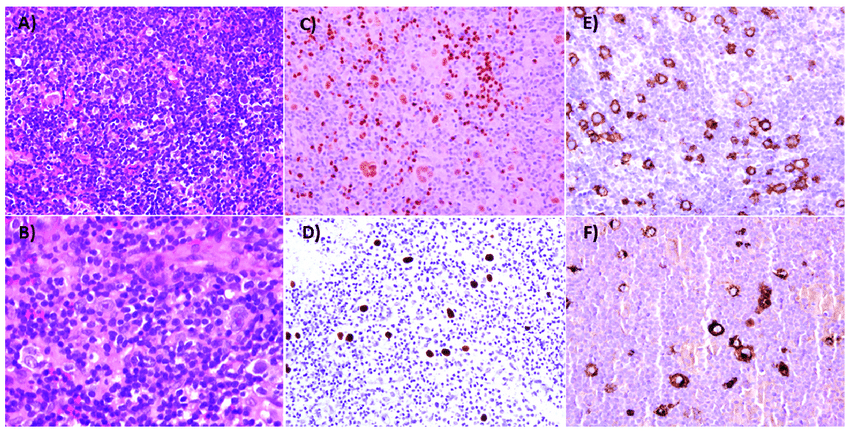
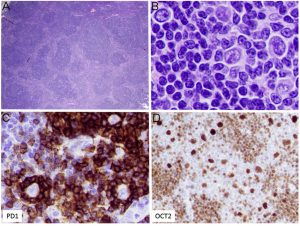
IHC findings of classical Hodgkin’s Lymphoma
Case Report: A 40-Year-Old Male with Generalized Lymphadenopathy Diagnosed with Hodgkin Lymphoma
Abstract
Hodgkin lymphoma (HL) is a malignant disorder of the lymphatic system characterized by the presence of Reed-Sternberg cells. Here, we report a case of a 40-year-old male presenting with generalized lymphadenopathy. Histopathological examination and immunohistochemistry confirmed the diagnosis of classic Hodgkin lymphoma (CHL). This case highlights the importance of early histopathological and immunohistochemical evaluation for accurate diagnosis and timely treatment.
Key words: Hodgkin lymphoma (HL), classic Hodgkin lymphoma (CHL), Histopathological examination (H/P), immunohistochemistry (IHC)
Introduction
Hodgkin lymphoma is a B-cell lymphoproliferative disorder that typically presents with painless lymphadenopathy. The diagnosis is confirmed through lymph node biopsy demonstrating Reed-Sternberg cells and a characteristic immunophenotypic profile. CHL is classified into four histological subtypes: nodular sclerosis, mixed cellularity, lymphocyte-rich, and lymphocyte-depleted. The mixed cellularity subtype is frequently seen in older patients and is associated with Epstein-Barr virus (EBV) infection.
Case Presentation
Patient Information
Age: 40 years
Gender: Male
Presenting Complaint: Generalized lymphadenopathy for 4 months
Associated Symptoms: No B symptoms (fever, night sweats, weight loss)
Past Medical History: No significant past medical illness
Family History: Non-contributory
Immunization history: Vaccinated
Clinical Examination
Generalised Lymphadenopathy:
Multiple enlarged, firm, non-tender, discrete enlarged lymph nodes, largest node is 5X4 cm in diameter.
Sites: Cervical, axillary, and epitrochlear
Systemic Examination:
- No hepatosplenomegaly
- No signs of bone marrow involvement
- ECOG Performance status: 1
Investigations
Haematological and Biochemical Tests
- Complete Blood Count (CBC): Hb-11gm/dl, TC of WBC- 10,000/mm3, Lymphocyte count- 1200/mm3
- Erythrocyte Sedimentation Rate (ESR):12mm in 1st hour
- Lactate Dehydrogenase (LDH): 380 u/L
- Serum Albumin: 4.2g/dl and Total Protein: Normal
- ALT, AST, ALK- Within normal limit
- HbsAg, Anti HCV, HIV: Negative
Histopathology (Lymph Node Biopsy): Lymph node architecture effaced by infiltrates of eosinophils, plasma cells, neutrophils, and histiocytes. Presence of mononuclear, binucleated giant cells, and popcorn cells.
Comment: Suggestive of Hodgkin lymphoma
Immunohistochemistry (IHC) Findings
Positive Markers:
CD30 (strong in large atypical cells), PAX-5, CD15 (weak positivity), OCT-2, BCL-6, PD-1, Ki-67 (60-65%)
Negative Markers:
CD3, CD20, CD45, CD8, CD10, MUM-1
Diagnosis
Based on histopathology and IHC findings, a diagnosis of Classic Hodgkin Lymphoma (CHL), Stage IIA, Early stage Favourable, Mixed Cellularity subtype.
Staging and Imaging
- PET-CT scan: Recommended to assess disease extent
- Bone Marrow Biopsy: Not indicated as CBC was normal
Discussion
Hodgkin lymphoma is a rare malignancy that primarily affects young adults but can present at any age. CHL accounts for approximately 95% of all Hodgkin lymphoma cases. The mixed cellularity subtype, seen in this patient, is more common in older individuals and those with HIV or EBV infection. The hallmark of CHL is the presence of Reed-Sternberg cells, which are CD30+ and CD15+, with negative CD45.
International prognostic scoring system for Hodgkin’s lymphoma
Risk factors
- Serum albumin <4 g/dL
- Hemoglobin-<10.5 g/dL
- Male gender
- Stage iv disease
- Age <45 years
- White blood cell count ≥15,000/mm3
- Lymphocyte count- <600/mm3 or <8% of white blood cells
Differential Diagnoses Considered:
- Nodular Lymphocyte-Predominant Hodgkin Lymphoma (NLPHL) – Typically CD30 negative and CD20 positive
- Peripheral T-cell lymphoma – CD30 can be positive, but usually lacks Reed-Sternberg cells
- Reactive Lymphadenopathy – Lacks Reed-Sternberg cells and clonal expansion
Management
Treatment Plan: Combined modality treatment (ABVD 4 cycle + 30Gy IFRT)
- First-line treatment: ABVD chemotherapy regimen (Adriamycin, Bleomycin, Vinblastine, Dacarbazine) for 4 cycles
- Radiotherapy: 30Gy IFRT
Prognosis: Favourable, as early-stage Classical Hodgkin’s Lymphoma (CHL) has a high cure rate with appropriate treatment. The outcome for Hodgkin lymphoma has improved significantly over the past decades, due to early cancer diagnosis and major advances in treatment. More people survive Hodgkin lymphoma than any other cancers. The 5-year relative survival rate is greater than 80% even when it is diagnosed at Stage IV. Almost 90% of patients with classical Hodgkin lymphoma go into remission (no sign of lymphoma left in the body) after first-line treatment. Hodgkin lymphoma is highly curable. It has the best survival outcome out of all cancers. Almost 9 in 10 people with classical Hodgkin lymphoma respond well and go into remission after first-line treatment. Remission means that there is no sign of lymphoma left in your body. Unlike other types of cancer, you can still go into remission or be cured from advanced stage (3 or 4) disease. Early studies of Interim PET/CT ( iPET) showed that achieving PET negativity early in the course of treatment was strongly associated with PFS and overall survival.
Follow up:
By PET/CT 5 point Deauville score. A score of 1 or 2 is considered a complete response and a score of 4 or 5 is considered a treatment failure. A score of 3 is sometimes considered a complete response, depending on the study.
Conclusion
This case highlights the importance of histopathological and immunohistochemical evaluation in diagnosing Hodgkin lymphoma. Early recognition and treatment are essential for a good prognosis, as CHL is one of the most curable malignancies with current therapeutic strategies.
References
- Mayo Clinic. Hodgkin’s Lymphoma (Hodgkin’s Disease) Symptoms and Causes. Accessed at https://www.mayoclinic.org/diseases-conditions/hodgkins-lymphoma/symptoms-causes/syc-20352646 on 24 July 2023.
- National Comprehensive Cancer Network. NCCN Guidelines for Patients 2023: Hodgkin Lymphoma. Pennsylvania, National Comprehensive Cancer Network; 2023.
- National Registry of Diseases Office. Singapore Cancer Registry Annual Report Infographic 2020. Singapore, National Registry of Diseases Office; 2022.
- HealthXchange.sg. Lymphoma Cancer: Hodgkin and Non-Hodgkin Lymphoma. Accessed at https://www.healthxchange.sg/cancer/lymphoma/lymphoma-cancer-hodgkin-non-hodgkin-lymphoma on 24 July 2023.
- American Cancer Society. What Causes Hodgkin Lymphoma. Accessed at https://www.cancer.org/cancer/types/hodgkin-lymphoma/causes-risks-prevention/what-causes.html on 24 July 2023.
- American Cancer Society. Hodgkin Lymphoma Risk Factors. Accessed at https://www.cancer.org/cancer/types/hodgkin-lymphoma/causes-risks-prevention/risk-factors.html on 24 July 2023.
- American Cancer Society. Tests for Hodgkin Lymphoma. Accessed at https://www.cancer.org/cancer/types/hodgkin-lymphoma/detection-diagnosis-staging/how-diagnosed.html on 24 July 2023.
- Lymphoma Australia. Hodgkin Lymphoma. Accessed at https://www.lymphoma.org.au/types-of-lymphoma/hodgkin-lymphoma/ on 24 July 2023.
- Mayo Clinic. Hodgkin’s Lymphoma (Hodgkin’s Disease) Diagnosis and Treatment. Accessed at https://www.mayoclinic.org/diseases-conditions/hodgkins-lymphoma/diagnosis-treatment/drc-20352650 on 24 July 2023.
- Gleneagles Hospital Singapore. Lymphoma Diagnosis and Treatment. Accessed at https://www.gleneagles.com.sg/conditions-diseases/lymphoma/diagnosis-treatment on 24 July 2023.
- Huang J et al. Incidence, Mortality, Risk Factors, and Trends for Hodgkin Lymphoma: A Global Data Analysis. Journal of Hematology & Oncology. 2022; 15:57; 1-11.
- American Cancer Society. Can Hodgkin Lymphoma be Found Early? Accessed at https://www.cancer.org/cancer/types/hodgkin-lymphoma/detection-diagnosis-staging/detection.html on 24 July 2023.
- Lymphoma Australia. Non-Hodgkin Lymphoma. Accessed at https://www.lymphoma.org.au/types-of-lymphoma/non-hodgkin-lymphoma/ on 24 July 2023.
- Surveillance, Epidemiology and End Results Program, National Cancer Institute. Cancer Stat Facts: Hodgkin Lymphoma. Accessed at https://seer.cancer.gov/statfacts/html/hodg.html on 24 July 2023.
- Surveillance, Epidemiology and End Results Program, National Cancer Institute. Cancer Stat Facts: Non-Hodgkin Lymphoma. Accessed at https://seer.cancer.gov/statfacts/html/nhl.html on 24 July 2023.
- National Foundation for Cancer Research. Hodgkin’s & Non-Hodgkin’s Lymphoma: What’s the Difference? Accessed at https://www.nfcr.org/blog/hodgkins-vs-non-hodgkins-lymphoma/ on 24 July 2023.
- American Cancer Society. Survival Rates for Hodgkin Lymphoma. Accessed at
- https://www.cancer.org/cancer/types/hodgkin-lymphoma/detection-diagnosis-staging/survival-rates.html on 24 July 2023.
- Cancer Research UK. Why Diet Is Important. Accessed at https://www.cancerresearchuk.org/about-cancer/coping/physically/diet-problems/about/why-diet-is-important on 24 July 2023.
- Cancer Research UK. Alternative Cancer Diets. Accessed at https://www.cancerresearchuk.org/about-cancer/coping/physically/diet-problems/managing/alternative-cancer-diets on 24 July 2023.